Mastering the Art of Flower 3D Layered Lasercut Designs for Professional Workflows
In the evolving landscape of digital fabrication and creative design, precision is not just a requirement; it is the foundation of quality. For designers, educators, small business owners, and hobbyists alike, the transition from a flat concept to a tangible, three-dimensional object requires tools that bridge the gap between imagination and execution. This is where Flower 3D Layered Lasercut designs become an invaluable asset. These are not merely static images but complex, multi-layered templates engineered specifically for laser cutting machines, allowing creators to produce stunning depth and texture through strategic stacking.
Integrating these assets into your workflow can significantly reduce preparation time while elevating the final output. Whether you are crafting intricate home decor, designing educational models, or producing bespoke gifts for clients, understanding how to leverage these files effectively is key to maintaining consistency and efficiency in your projects.
Understanding the Structure and Utility of Layered Designs
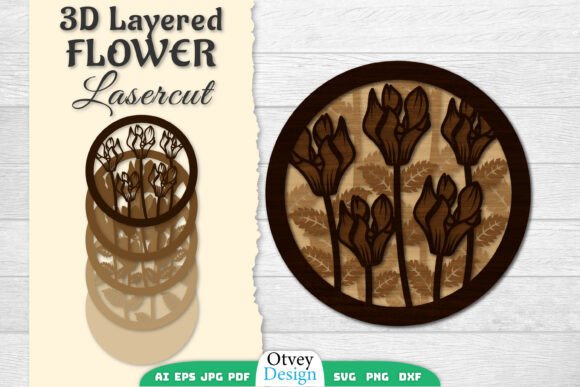
A Flower 3D Layered Lasercut file is fundamentally different from standard vector graphics. It is constructed with multiple distinct layers, each representing a specific plane of the final object. When cut from materials like wood, acrylic, or cardstock, these layers are stacked to create a shadow-box effect or a true 3D relief. This technique adds visual weight and sophistication that single-layer cuts simply cannot achieve.
For professionals, this means the heavy lifting of spatial planning has already been done. The designer has calculated the necessary offsets, tab placements, and alignment markers. Your role shifts from architectural drafting to production management. This allows you to focus on material selection, finish quality, and assembly techniques rather than spending hours adjusting vector paths to ensure they fit together physically.
Seamless Integration into Your Creative Pipeline
The true value of these digital assets lies in their compatibility and ease of integration. A well-structured design package should fit smoothly into various stages of your project lifecycle, from initial prototyping to final mass production. Here is how you can incorporate these files into your existing workflows:
- Pre-Production Planning: Use the provided preview images (JPG/PNG) to visualize the final product before committing resources. This helps in client presentations or personal project planning, ensuring the aesthetic aligns with your goals.
- Machine Setup: Import the vector files (SVG, DXF, AI, EPS) directly into your laser control software. Because these formats are industry standards, they minimize the risk of translation errors that often occur when converting between proprietary formats.
- Material Testing: Before cutting your final premium material, use the PDF or DXF files to run test cuts on scrap material. This step is crucial for dialing in power and speed settings, ensuring clean edges and proper fit for the layered assembly.
By treating the Flower 3D Layered Lasercut file as a modular component of your larger process, you maintain flexibility. You can swap materials, adjust scales, or modify colors without altering the core structural integrity of the design.
Navigating File Formats for Maximum Efficiency
One of the most critical aspects of working with digital cut files is understanding which format serves which purpose. A comprehensive package ensures you are never locked out of your workflow due to software incompatibility. When you acquire a high-quality design bundle, you should expect a diverse range of formats, each serving a specific function in your toolkit.
Here is a breakdown of what you typically receive and how to utilize each format effectively:
- AI File (Adobe Illustrator): Ideal for designers who need to make precise edits to the vector paths. If you need to resize specific elements or add custom text, this editable source file is indispensable.
- PDF File: Perfect for quick viewing, printing templates for manual reference, or sharing with clients who do not have specialized design software. It preserves the vector quality while being universally accessible.
- EPS File: A robust vector format compatible with a wide array of design programs beyond Adobe, such as CorelDRAW or Inkscape. It ensures scalability without loss of quality.
- JPG File: Used primarily for previews, marketing materials, or social media posts. It helps you showcase the potential of the design before fabrication.
- PNG File: Similar to JPG but with transparency support. This is useful for overlaying the design onto different background textures in digital mockups.
- SVG File: The gold standard for web-based cutting software and many modern laser controllers. It is lightweight, scalable, and widely supported by consumer-grade machines.
- DXF File: Essential for users of CAD software or older laser systems that prefer this format. It ensures geometric accuracy and is widely used in industrial applications.
Having access to all these formats means you are prepared for any technical constraint. Whether your client uses a specific machine or your own software updates change compatibility requirements, you remain agile and productive.
Quality Control and Assembly Best Practices
Receiving the files is only the beginning. The quality of your final Flower 3D Layered Lasercut piece depends heavily on execution. To ensure professional results, consider the following practical tips during the implementation phase:
Material Consistency: Since the design relies on layering, uniform thickness is critical. If one layer is slightly thicker than the others due to material variance, the alignment pins may not fit, or the final stack may lean. Always measure your material stock before starting a batch.
Kerf Compensation: Laser beams remove a small amount of material during cutting, known as the kerf. High-quality SVG and DXF files often account for this, but it is wise to verify with a test cut. If the layers are too tight, the assembly will be difficult; if too loose, the structure will be unstable.
Organization and Labeling: When cutting multiple layers, it is easy to mix them up. Use the PNG or JPG references as a guide to label each cut piece immediately after removal from the machine. This simple step saves significant time during the gluing and assembly process.
Expanding Your Creative Horizons
Beyond immediate projects, investing in versatile design assets like these supports long-term growth. For educators, these files can serve as the basis for lessons on geometry, art history, or engineering principles. For entrepreneurs, they offer a ready-to-sell product line with minimal upfront design costs. For hobbyists, they provide a satisfying, achievable challenge that yields beautiful results.
The versatility of the Flower 3D Layered Lasercut concept allows it to transcend niche applications. You might use the same underlying structure to create wall art, lamp shades, jewelry displays, or even complex puzzle games. The key is to view the file not as a static end-product, but as a flexible tool in your creative arsenal.
Final Thoughts on Implementation
Success in digital fabrication is rarely about having the most expensive machine; it is about having the right resources and knowing how to use them efficiently. By incorporating pre-designed, multi-format layered files into your workflow, you eliminate common bottlenecks associated with design creation. You gain the freedom to focus on craftsmanship, customer service, and creative experimentation.
Remember, the goal is not just to cut a shape, but to create an experience. Whether that experience is for a client receiving a custom gift, a student learning about spatial reasoning, or yourself enjoying the meditative process of assembly, the quality of your input determines the quality of your output. Choose files that offer comprehensive support, multiple formats, and clear structures. Do not hesitate to invest in products that streamline your process and elevate your work. If there is something you don’t understand about the file structure or compatibility, always reach out to the creator. Clear communication ensures that your investment yields the highest possible return in both time saved and quality achieved.
Embrace the precision, enjoy the process, and let these layered designs bring depth and dimension to your next project.