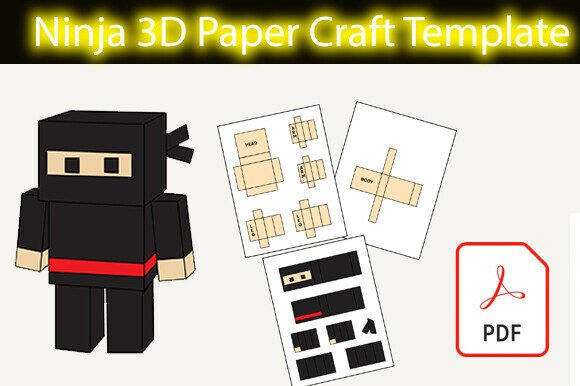
Ninja 3D Paper Craft Template: A Practical Guide for Customizable Play
In the landscape of DIY paper toys and educational resources, the Ninja 3D Paper Craft Template stands out as a unique tool that bridges the gap between simple flat coloring pages and complex, time-consuming model kits. Designed with a modular architecture, this resource allows users to construct a block-style ninja base once and then interchange slide-on clothing pieces to create diverse characters. For parents, educators, and hobbyists seeking a balance between creative engagement and practical utility, understanding how this template functions—and where it fits among other crafting options—is essential for making an informed choice.
The Modular Advantage of Block-Style Design
What distinguishes the Ninja 3D Paper Craft Template from standard paper crafts is its separation of form and function. Traditional paper dolls often rely on flaps or tabs that can tear easily after repeated use. In contrast, this template utilizes a sturdy, block-style base constructed from the head, body, arms, and legs. Once assembled, this core structure remains intact. The innovation lies in the slide-on clothing pieces, which are designed to fit over the base without requiring permanent adhesives.
This design offers a significant advantage in longevity and reusability. Unlike single-use cutouts, the modular nature means the "ninja" character can be dressed for different scenarios—a stealth mission, a training exercise, or a festive event—simply by swapping the outer layers. This approach transforms a static craft into an interactive toy, encouraging children to engage in narrative play rather than just completing a one-time assembly task. The ability to customize the look without rebuilding the entire figure saves time and materials, making it a sustainable option for classrooms and homes alike.
Comparing Formats: Color vs. Black-and-White Versions
When evaluating the Ninja 3D Paper Craft Template, one must consider the two primary formats provided: the pre-colored version and the black-and-white outline. Each serves a distinct purpose depending on the user's goals and available time.
- The Color Version: Ideal for quick assembly and immediate gratification. This format is particularly useful in classroom settings where time is limited, or for younger children who may find the coloring process tedious. It allows the focus to remain on the 3D construction and the mechanics of sliding the clothes on and off.
- The Black-and-White Version: Offers maximum creative freedom. This format encourages artistic expression, allowing users to choose their own color palettes, patterns, and designs. It is better suited for art projects, homeschooling activities focused on fine motor skills and color theory, or older children who enjoy personalizing their creations.
While some digital craft resources force a choice between these formats, the inclusion of both in this template set provides flexibility. However, users should note that the black-and-white version requires additional supplies such as markers, crayons, or colored pencils, whereas the color version only requires a printer and scissors.
Evaluation Against Alternative Crafting Methods
To determine if the Ninja 3D Paper Craft Template is the right resource, it is helpful to compare it against other common approaches to creating paper figures.
Traditional Flat Paper Dolls
Standard paper dolls are typically two-dimensional figures with separate clothing pieces that attach via small slits or glue. While they are easy to print and assemble, they lack depth and durability. The 3D nature of the Ninja template provides a more tactile experience, enhancing spatial awareness and fine motor skills. Furthermore, the slide-on mechanism is generally more robust than the fragile tabs found on traditional paper dolls, reducing frustration during play.
Complex Origami and Model Kits
On the other end of the spectrum are intricate origami models or detailed plastic model kits. These often require advanced folding techniques, patience, and sometimes specialized tools like tweezers or glues. While impressive, they can be discouraging for young children or those looking for a quick activity. The Ninja template strikes a middle ground; it offers a 3D result but relies on simple folding along solid lines and basic taping, making it accessible to a wider age range without sacrificing the satisfaction of building something tangible.
Digital Character Creators
In an era dominated by screens, digital avatar creators offer endless customization. However, they lack the physical engagement of hands-on crafting. The Ninja 3D Paper Craft Template provides a screen-free alternative that still satisfies the desire for customization. The physical act of cutting, folding, and assembling engages the brain differently than clicking through digital menus, offering a sensory-rich experience that supports cognitive development in ways virtual tools cannot.
Strengths and Tradeoffs in Real-World Application
Every resource has limitations, and the Ninja template is no exception. Understanding these tradeoffs helps in setting realistic expectations.
Strengths:
- Reusability: The core strength is the ability to change outfits repeatedly, extending the life of the craft significantly.
- Educational Value: It promotes STEM-related skills such as geometry (understanding 3D shapes), engineering (assembly), and problem-solving.
- Versatility: Suitable for various environments, from structured classroom lessons to unstructured home play.
Tradeoffs and Limitations:
- Paper Quality Dependency: As with all paper crafts, the durability depends heavily on the paper stock used. Standard printer paper may warp or tear quickly with rough handling. For best results, cardstock is recommended, which may increase material costs slightly.
- Assembly Time: While faster than complex kits, the initial assembly of the base does require time and adult supervision for younger children to ensure proper folding and taping.
- Customization Limits: Unlike drawing from scratch, the customization is confined to the provided templates. Users cannot alter the fundamental shape of the ninja without modifying the source file, which may limit creativity for advanced users.
Decision Factors: When to Choose This Template
The Ninja 3D Paper Craft Template is not a universal solution for every crafting need, but it excels in specific scenarios. Consider this resource when:
- You need a reusable toy: If you want a craft that lasts beyond a single afternoon, the modular design is superior to disposable alternatives.
- Fine motor skill development is a priority: The cutting, folding, and precise alignment required for the slide-on pieces are excellent exercises for hand-eye coordination.
- Group activities are planned: In a classroom or party setting, the simplicity of the instructions allows multiple children to work simultaneously without needing extensive guidance.
- Screen time reduction is a goal: It offers a compelling, engaging physical alternative to video games or tablets.
Conversely, you might look for other options if your primary goal is purely artistic expression without structural constraints, or if you require a highly durable toy made of plastic or wood. Additionally, if the target audience consists of very young toddlers (under three), the small parts and assembly steps might present a safety challenge or require constant adult intervention.
Practical Implementation and Best Practices
To maximize the value of the Ninja 3D Paper Craft Template, preparation is key. Printing on heavier cardstock will yield a sturdier final product that withstands the friction of sliding clothing pieces. Using clear tape rather than glue for the base assembly ensures that the joints remain flexible and less prone to cracking. When using the black-and-white version, encourage users to think about the context of the ninja's outfit—perhaps designing camouflage patterns for a forest mission or bright colors for a celebration.
For educators, this template can serve as a versatile lesson plan component. It can be integrated into history units discussing martial arts, art classes focusing on 3D modeling, or language arts sessions where students create stories about their custom ninjas. The ability to swap costumes facilitates dynamic storytelling, allowing the same character to appear in different chapters of a narrative.
Conclusion on Suitability and Value
The Ninja 3D Paper Craft Template represents a thoughtful evolution in paper crafting, moving away from static images toward interactive, modular play. By balancing ease of use with the potential for customization, it addresses many of the frustrations associated with traditional paper dolls while avoiding the complexity of professional model kits. While it requires some upfront investment in time and materials, the resulting reusable toy offers lasting entertainment and educational benefits. For adults weighing their options for kids' crafts, homeschooling projects, or DIY toys, this template provides a practical, engaging, and cost-effective solution that prioritizes hands-on creativity.